
How Close Has the Computer Become?
From the Desk to the Body
When Steve Jobs introduced the Macintosh, he unveiled a computer weighing around 7 kg.
At the time, computers were fixed to desks, immovable and confined.
Yet this machine was revolutionary — not because it was small by today’s standards, but because it was light enough to be carried.
It marked the beginning of the personal computer as something that could move with you.
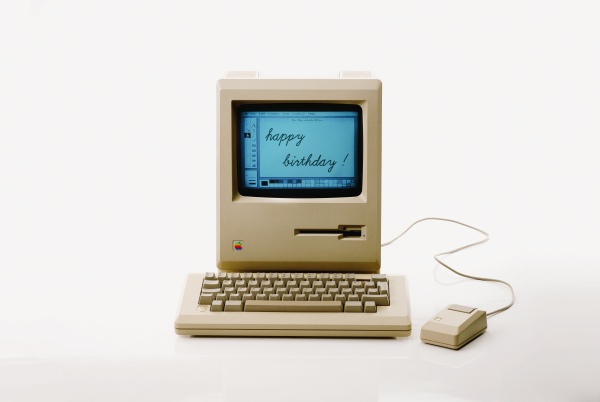
Since then, computers have steadily become lighter and smaller, drawing ever closer to our bodies.
From the desk to the bag, from the bag to the palm of the hand — and now, they are moving beyond the hand, into our field of vision.
The Great Expansion: Internal Shrinking, External Growing
This shift is not merely about improved performance.
It stems from a fundamental restructuring.
Modern computers operate like organisms with separated senses and muscles.
Immediate sensory processing happens locally on the device, while large-scale reasoning and complex computation are delegated to vast external cloud systems.
In this sense, computers have not simply shrunk.
Alongside the miniaturization of semiconductor chips, they have simultaneously expanded outward without limit, transforming into an entirely new kind of system.

Beyond the Screen
Displays, too, are breaking free from their rectangular constraints.
Once bulky like CRT monitors, screens became thinner, and now they are projected directly onto reality through lenses.
The display is no longer tied to a physical surface, gradually escaping the limitations of size and placement.
Battery efficiency has also evolved — not just through better storage technology, but through more intelligent operation.
Instead of running all functions continuously, systems now activate only the necessary sensory processes while offloading the rest across networks.
This creates a structure that sustains longer operation within limited energy.
Ultimately, all these changes converge along a single trajectory.
Computers have become smaller, thinner, and more enduring.
They are no longer devices we hold in our hands — they are becoming extensions of the body, rising onto our faces.
The physical distance has finally approached zero.
The computer is no longer something we look at, but something we experience — an inseparable layer of our perception.

Comments